
city snapshots
The following City Snapshots introduce 13 community-led transportation projects in cities across the country and offer a glimpse into the historical legacies that have created the conditions these communities seek to change.
City Snapshots are a tool to help local project teams contextualize their efforts, plan in ways that acknowledge and repair historic harms, and communicate effectively about their work.













about the erc Initiative
City Snapshots were developed as part of the Equitably Connecting Communities (ERC) Initiative.
Launched in 2023, the ERC Initiative was a $10,000,000 investment by the Robert Wood Johnson Foundation to support small and midsize cities in advancing community visions for redressing harmful transportation infrastructure. The ERC Initiative built on the 2022 Federal Reconnecting Communities Pilot program by generating knowledge and tools to ensure that these major reconnection projects are conducted equitably — advancing the visions of historically marginalized residents, without replicating the harmful patterns of the past.
Key components of the ERC Initiative included:
Building Capacity
✶
Smart Growth America established the Community Connectors program to provide capacity-building for cross-sector project teams in small and midsized cities across the country.
Community Connectors
✶
Communities First Infrastructure Alliance and several philanthropy-serving organizations convened philanthropic, government, and community-based organizations from the federal, state, and local levels to advance systemic change.
Learning and Communicating
✶
Equivolve documented learnings from the ERC Initiative and translated them into strategy and actionable resources, including these City Snapshots.
✶
StoryCorps brought together neighbors, family members, students, and teachers from impacted communities across America to discuss what change might look like.



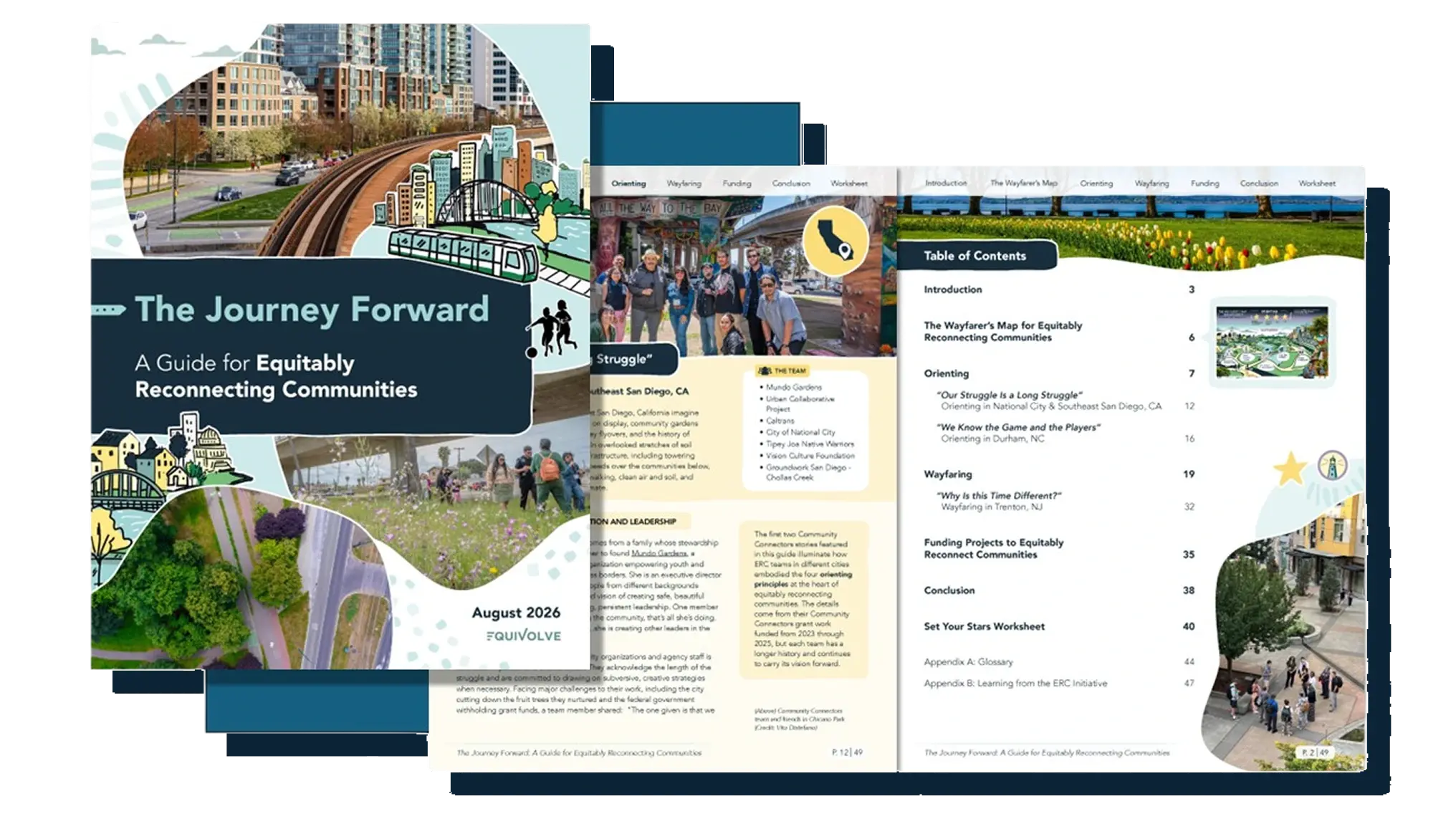
A major theme emerged from Equivolve’s work with the ERC Initiative: Equitably connecting communities requires a new process for planning transportation infrastructure.
The Journey Forward articulates that process – a way to engage in planning and decision-making that advances community visions without repeating old patterns and creating new harm. If you are a resident, community organization, public agency, or funder working to transform transportation infrastructure and contribute to the health of your community, this guide is for you.
Do you want to make your own City Snapshot?
The Setting Your Stars Worksheet can get you started. See page 49 of The Journey Forward.
The City Snapshots draw from principles of mobility justice: the idea that everyone should be able to move safely, joyfully, and freely, and that the people living with a decision should help make it. Over the last decade, this notion has evolved into established practices within academic research, for grassroots organizing, and new approaches to planning practice, all asking the same question about power: Who gets to make decisions about who moves freely – and who doesn't?
Mobility justice begins with an understanding of the ways that transportation infrastructure and practices have historically excluded or harmed groups of people, particularly communities of color, in order to heal the harms of the past and build transportation systems that work for all.


Building systems that work for everyone requires that we acknowledge the unjust histories of mobility and economic prosperity in American cities.
A mobility justice approach to transportation planning includes facilitating dialogue, funding the participation of people and community organizations who are directly affected, and establishing partnerships that lead to the shared decision-making that is necessary for meaningful repair.
By taking a mobility justice approach, government agencies and elected officials can advance transportation policies, programs, and projects that bring community-driven visions to life.
Mobility Legacies
Each City Snapshot offers local historical context related to mobility justice. The mobility legacies are organized according to five themes.
These mobility legacies do not provide exhaustive histories of the cities. Rather, they point to harmful policies and decisions and, subsequently, opportunities for repair and reconnection.


forced migrations


Industrialization and Uneven Economic Mobility


Urban Renewal & Disruption


Ecological & Environmental Impacts


Public Safety